
COMPARE
Bookkeeper, fractional CFO or the Command Bar: who does what
When the numbers start to feel like too much, most owners think about hiring help: a bookkeeper, or a part-time CFO. Both are good hires. They just do different jobs, and neither one sits with you every morning.

What a bookkeeper does
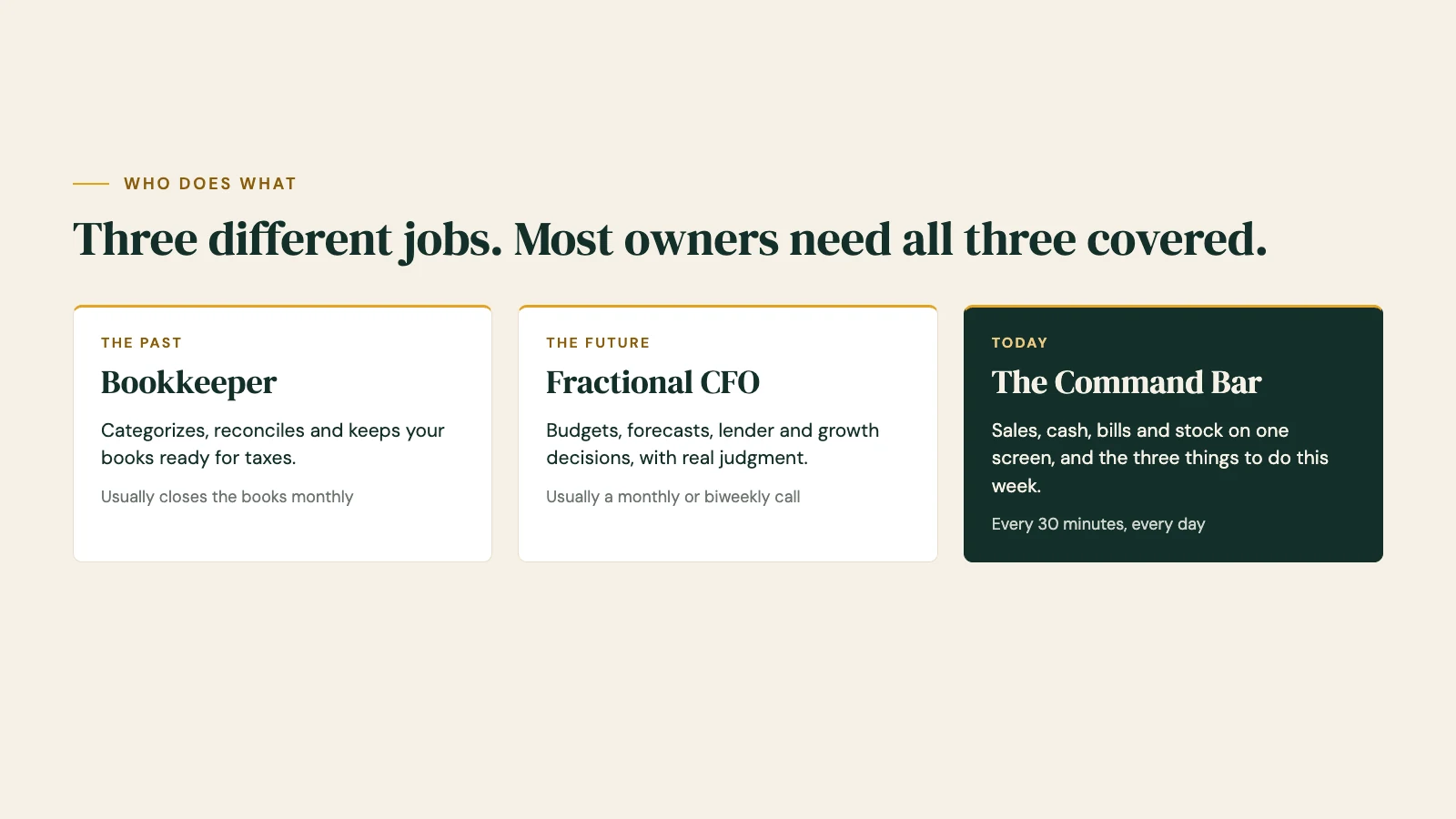
A bookkeeper categorizes your transactions, reconciles your accounts and keeps your books ready for your accountant and your taxes. Published plans we found start around $300 to $400 a month for books closed monthly, and more if you want them closed every week.
You need this. The Command Bar doesn't replace it, and we'd never suggest it does.
What a fractional CFO does
A fractional CFO is a part-time finance leader. They build budgets and forecasts, look at where your margins are going, help you talk to a lender, and bring real judgment to big decisions like a second location. Published plans start around $1,750 to $2,000 a month and go up from there.
That's real value, and some owners need it. But it's a lot to pay before you know what your numbers are telling you.
The 13-week cash view, without the CFO bill
One of the most useful things a CFO builds is a 13-week cash flow: how much cash you'll have each week after every bill, loan and payroll. At least one national firm lists it only in its custom CFO plan, which starts at $5,250 a month.
The Command Bar shows your cash 13 weeks out on your board, updated every 30 minutes, alongside your sales, stock and bills. It won't replace a CFO's judgment. It does mean you walk into every conversation already knowing where you stand.

Bookkeeper, fractional CFO and the Command Bar, side by side
| Bookkeeper | Fractional CFO | The Command Bar | |
|---|---|---|---|
| Typical cost | From about $300 to $400 a month | From about $1,750 to $2,000 a month | From $1,500 setup and $199 a month |
| Main job | Keeps the books accurate and tax-ready | Plans, forecasts and advises | Shows the business today and what to do this week |
| How often you see numbers | When the books close, often monthly | On your call, monthly or every two weeks | Every 30 minutes |
| 13-week cash view | Not usually | Often, on higher plans | Yes, on your board |
| Sales, stock and what to reorder | No | Sometimes, in a model | Yes, from your point of sale |
| Judgment and advice | Questions about your books | Yes, that's the job | No. It shows the numbers; you make the call |
| Taxes and filings | Gets your books ready | Plans around them | No. It's not tax advice |
When you need a bookkeeper
Almost always. If you don't have one, start there. Clean books make every other number better, including the ones on your board.
When a fractional CFO is worth it
- You're raising money, buying a business or taking on a large loan.
- You're opening locations fast and need a full financial model.
- You want someone experienced to own the finance side and tell you what they'd do.
When the Command Bar is the better first step
- You already have a bookkeeper, but you only see your numbers once a month.
- You want to know cash after every bill, every day, not on a monthly call.
- You need to know what to reorder and what to move between stores.
- You're not ready to spend $2,000 or more a month on advice.
Use them together
The best setup is all three working together. Your bookkeeper keeps the books clean. The Command Bar shows you today and flags what needs attention. And if you bring on a CFO later, they start from a board that's already current instead of building one from scratch.
How setup works
- A short intake call. Tell us your systems, your stores and your bills, and we give you a go-live date.
- You connect your accounts with view-only access. We never ask for your passwords.
- We build your board and walk you through it. Billing for the month only starts when your board goes live.
If you already work with a bookkeeper or a CFO, bring them to the intake. They'll see exactly what the board shows and where it comes from.
Questions
Does the Command Bar replace my bookkeeper?
No. Your bookkeeper keeps your official books and gets them ready for taxes. The Command Bar shows the day-to-day picture next to them.
Can the Command Bar replace a fractional CFO?
Not the judgment. It gives you the daily numbers and the 13-week cash view a CFO would build, so you can decide when you actually need one.
How much does a fractional CFO cost for a small business?
Published plans we found start around $1,750 to $2,000 a month, and higher plans with more support cost more. Many also charge for one-time projects like a budget or a forecast.
What's the difference between a bookkeeper and a CFO?
A bookkeeper records what happened and keeps the books accurate. A CFO uses those numbers to plan what happens next. One looks back, the other looks ahead.
Will my bookkeeper or CFO be able to see the board?
Yes, if you want them to. You decide who gets the password.
What does it cost?
Core is $1,500 to set up and $199 a month. Full is $3,000 and $349 a month. That's launch pricing for our first ten businesses, locked for the first year. See plans
Know where you stand before the next meeting.
View-only access · Nothing can move your money · Your data stays yours
Bookkeeping and CFO prices are starting prices published on bookkeeper360.com and pilot.com, October 2026. Your quotes may differ. The Command Bar isn't accounting, tax, legal or investment advice.
MORE COMPARISONS
Spreadsheet vs dashboard: why your numbers are old the moment you hit send
Why your numbers are old the moment you hit send, and when a spreadsheet is still the right tool.
Shopify reports vs the Command Bar: what Shopify can't see
Shopify's reports are good at sales and stock. Here's what they can't see, and why most owners keep both.
Square Dashboard vs the Command Bar: the money outside Square
Square shows what runs through Square. Here's the money it can't see, and why Square owners can keep both.
QuickBooks reports vs the Command Bar: your books vs your week
QuickBooks keeps your books. Here's why the day-to-day picture needs something faster, and why owners keep both.
Fathom vs the Command Bar: reports from your books vs a board from your business
Fathom turns your books into polished reports. Here's how that differs from a live board of your business, and when to use each.